Distributed Systems
Texas has 474 gigawatts of demand it does not believe in
Texas stopped approving data centre grid connections in August 2026 - not because the grid is full, but because nobody can tell which of the 474 gigawatts of requests are real. That is not an energy story.
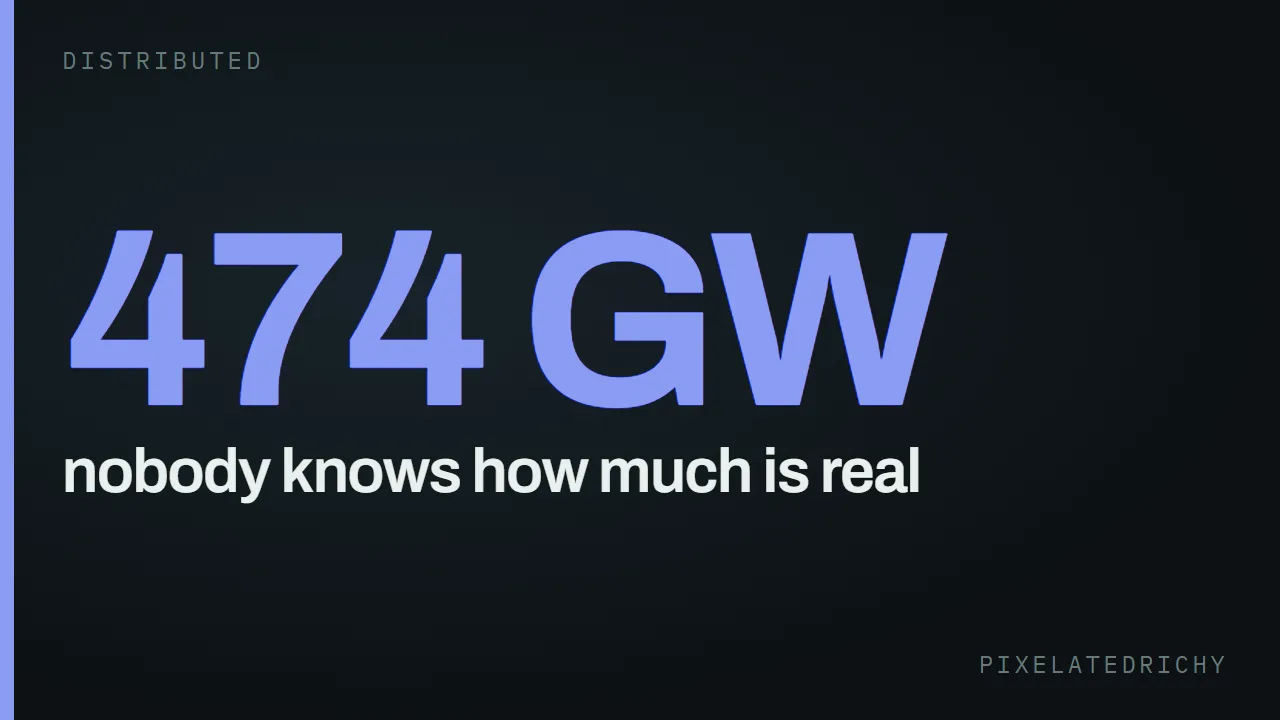
The grid operator that runs most of Texas is currently tracking requests for four hundred and seventy-four gigawatts of electricity. The state's all-time record for actual electricity use is a fraction of that. Governor Greg Abbott put it at less than a fifth.
And in August, the state stopped approving those requests. Not because the grid ran out of room. Because nobody can tell which of the requests are real.
Why it matters
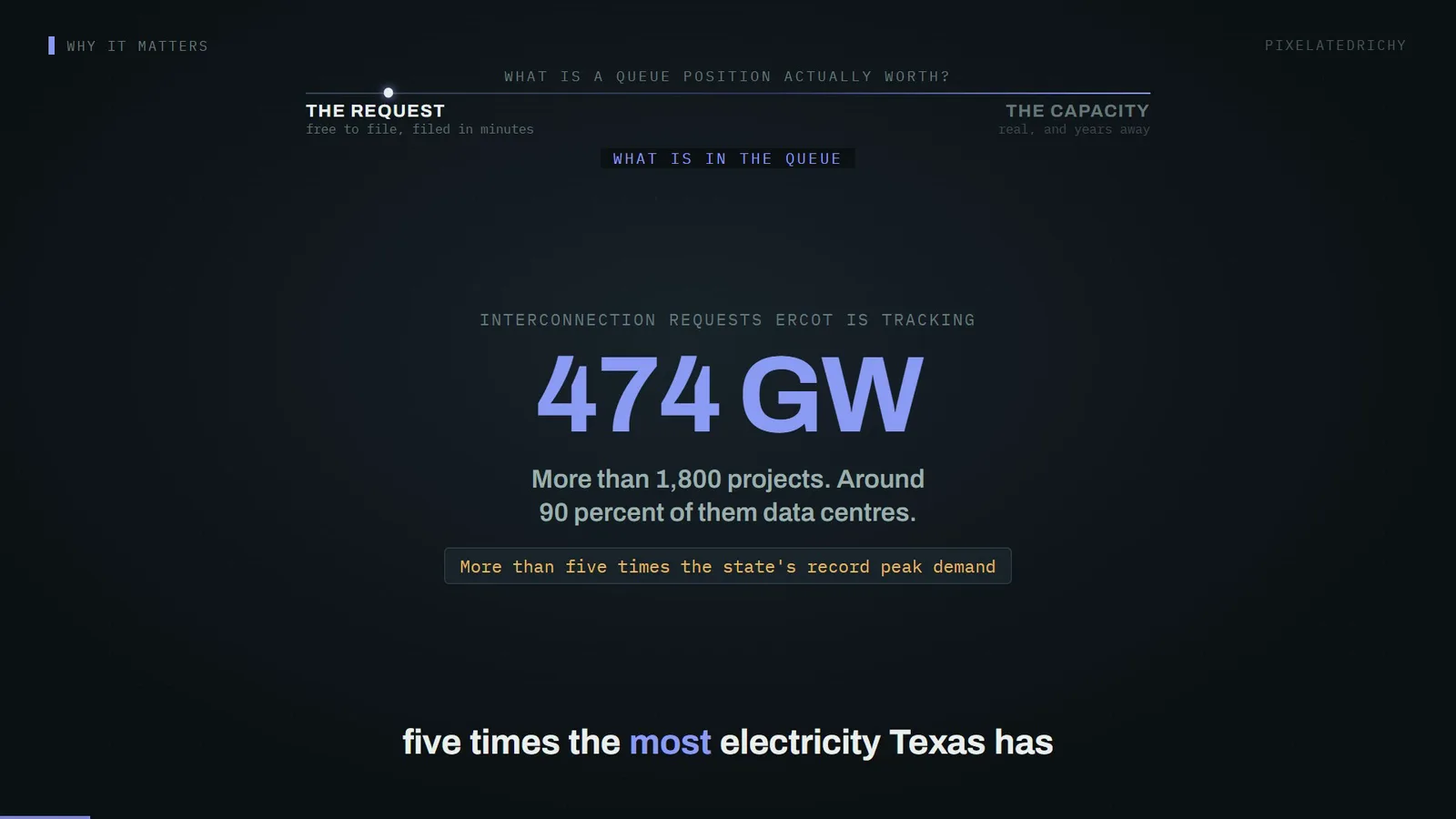
Those are the grid operator's own numbers, and the ninety percent figure is the governor's. Over eighteen hundred projects. Together they ask for more than five times the most electricity Texas has ever used at once.
Nobody has published how much of it is real. Including ERCOT.
Now, the obvious reading is that this is a data centre story, and there is a version of it that is. That is not the version I want to do, because the interesting thing here is not about data centres at all.
A queue you can join for free stops being a measurement.
By the end of this you will be able to look at any system that lets people reserve capacity ahead of using it - a scheduler, a connection pool, a rate limiter, a booking system - and predict exactly how it fails. Texas is running the largest live demonstration of that failure anyone has built. You have probably shipped a small one.
The mental model
Start with what an interconnection queue is, because it is a shape you already know. Someone who wants a very large amount of power files a request naming a location and a size. The operator then studies what connecting that load would do to the network. If the study clears, an agreement gets signed, and eventually the thing is allowed to switch on.
The study is the slow, serial, expensive step.
The study is the part that matters. It is slow, it costs real engineering time, and crucially it is not independent - what you can safely connect at one substation depends on what everyone else has already been promised at the substations around it.
So the whole tower rests on one assumption at the bottom. It is never written down anywhere, because it is too obvious to write down.
A request represents an intention to actually use the thing.
Every queue ever built assumes that. A restaurant booking assumes you mean to eat. A thread pool assumes a borrowed thread will do work. It is a reasonable assumption, and it holds right up until the moment that filing a request becomes cheaper than deciding whether you want it.
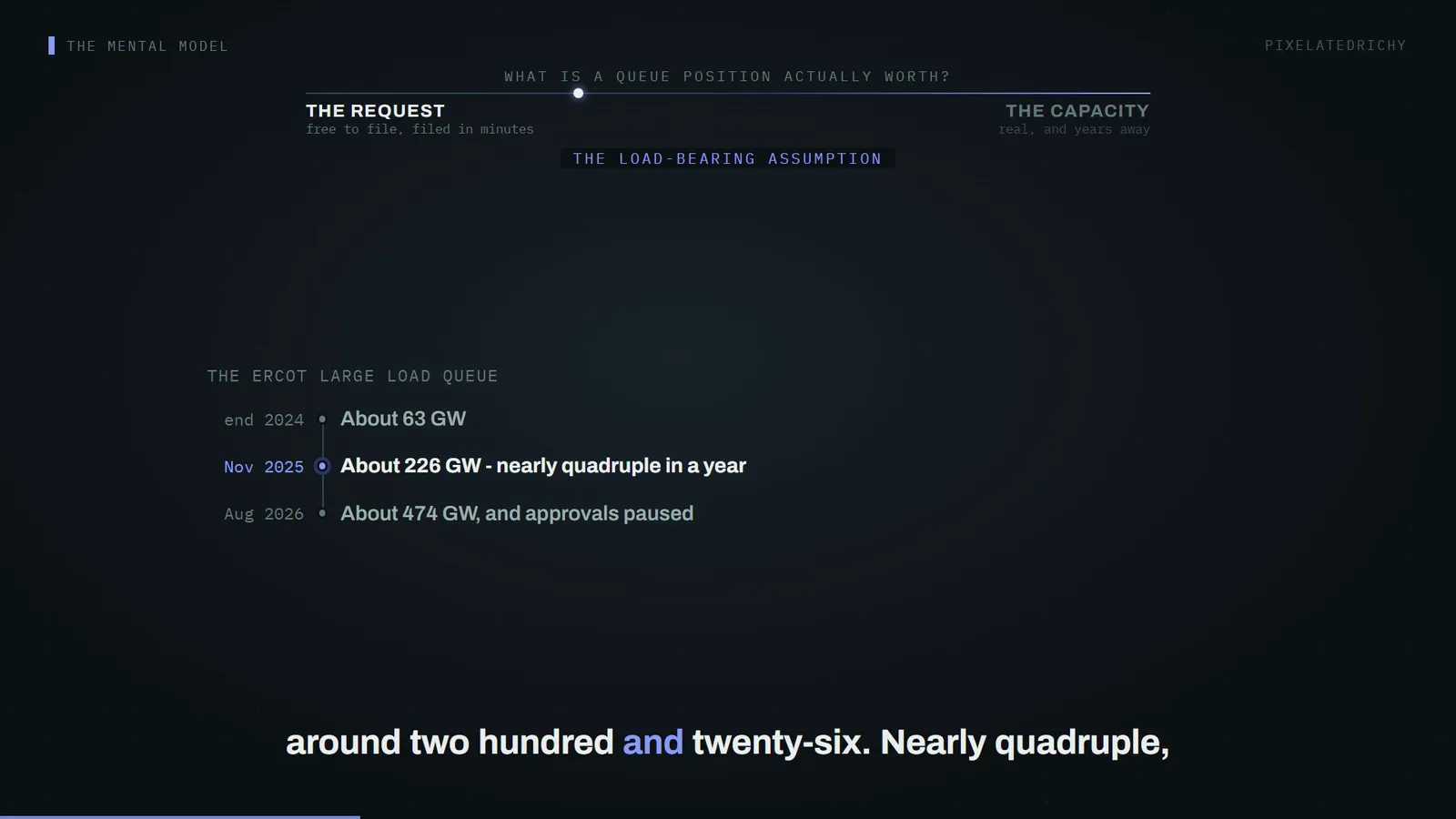
Watch what happened to the assumption. At the end of twenty twenty-four the queue held about sixty-three gigawatts.
By November of twenty twenty-five it was around two hundred and twenty-six. Nearly quadruple, in a single year.
Capacity cannot grow like this. Only requests can.
And by August of this year, four hundred and seventy-four. That is not a demand curve. Nothing physical grows like that. That is the shape of a number that is cheap to increase.
The mechanism
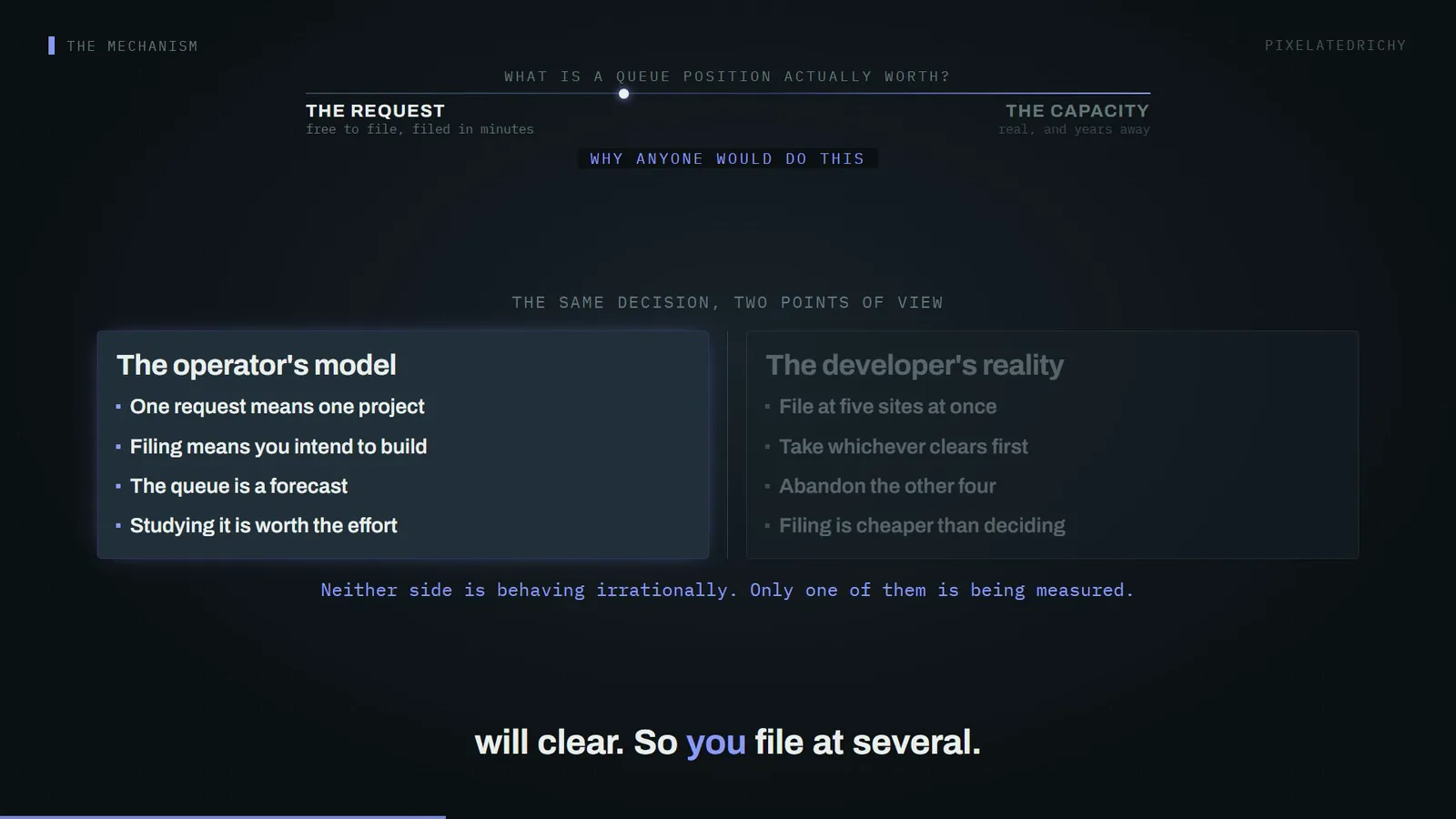
Here is the mechanism, and I want to be fair to the developers, because none of this requires anyone to act in bad faith. If you are trying to build something that needs an enormous amount of power, the binding constraint is finding somewhere that can actually supply it. You do not know in advance which location will clear. So you file at several. You take the first one that comes through, and you quietly let the others lapse.
Filing five requests is rational. It is also four lies to the forecast.
That is a completely sensible strategy for the developer. It is also, from the operator's side, four requests that were never going to become anything, sitting in the queue consuming study effort and inflating the forecast.
The economics word for what they have been handed is an option. A queue position is the right to connect, without the obligation to. And the price of that option is the cost of filing. Set that price near zero and you should not be surprised by the volume.
And the damage is not only that the forecast is wrong. The studies are serial and interdependent, which means a request that will never become anything still sits in front of one that would have. The real project waits behind the ghost.
Same shape as head-of-line blocking. Different units.
If you have ever watched one slow request at the front of a connection pool stall every healthy request behind it, this is that, with substations instead of sockets and years instead of milliseconds.
Look at where the costs actually land. Moving forward through this machine costs the operator engineering time at every step. Dropping out costs the developer almost nothing, at any step. That asymmetry is the whole disease.
So what do you do about it? There are only three levers, and every system that has solved this has used some mixture of them. Charge for the reservation itself. Require evidence that the request is backed by something. Or go through periodically and throw out what is not real.
Proportional. A flat fee does not ration anything.
And the first lever has a condition attached that is easy to miss. The charge has to scale with what is being reserved. A flat fee is not a price, it is a toll.
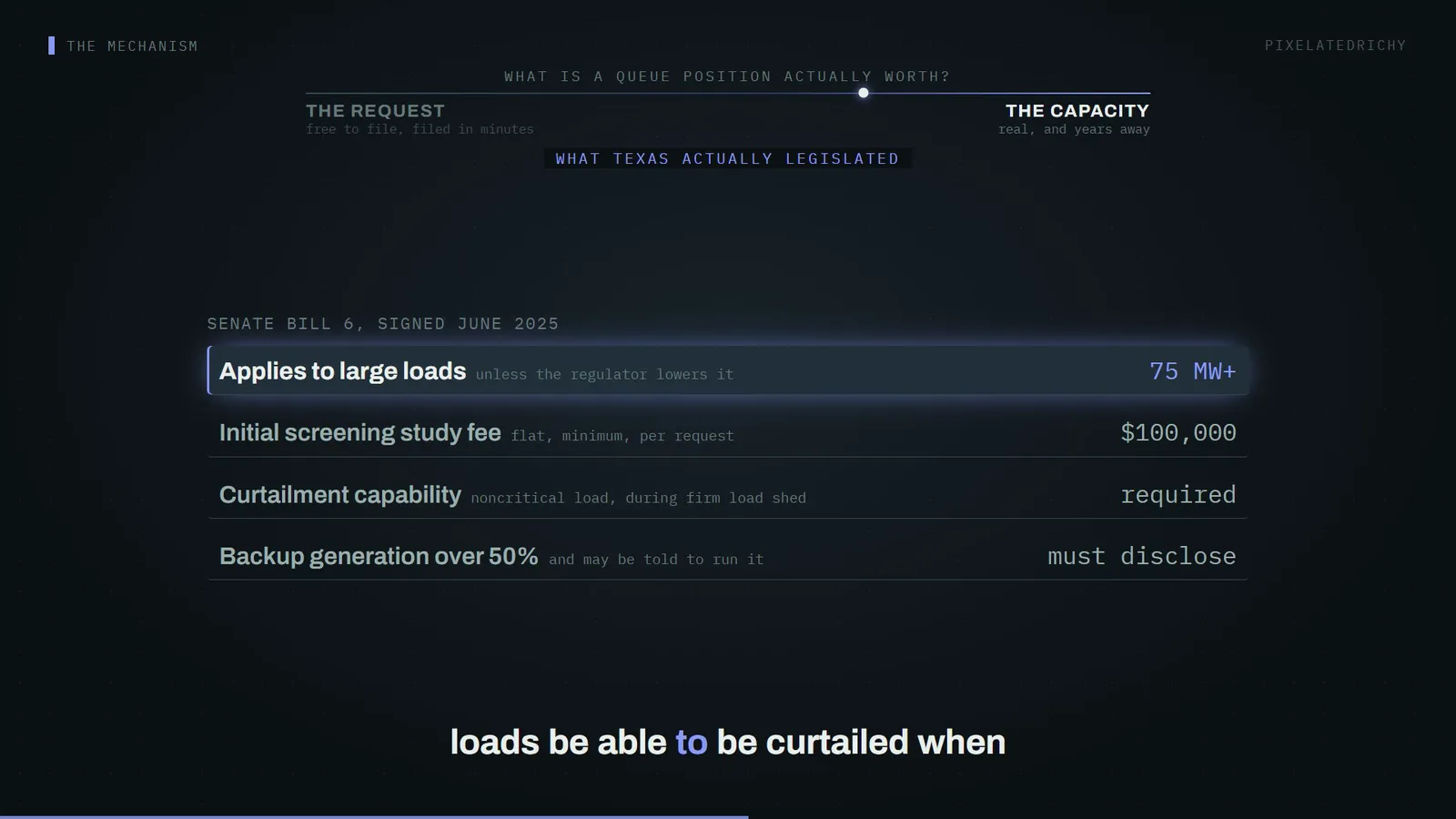
Texas did legislate. Senate Bill Six, signed in June last year, set the threshold for a large load at seventy-five megawatts, required a flat screening study fee of at least a hundred thousand dollars, and - this part is genuinely good engineering - required that these loads be able to be curtailed when the grid is short.
Load shedding, agreed in advance, in writing.
That last one is worth pausing on. Curtailment is load shedding negotiated ahead of time. The grid gets the right to disconnect you during an emergency, and you agree to it in exchange for being connected at all. That is backpressure, written into a contract.
But look again at the fee. A flat hundred thousand dollars.
The fee, though. A hundred thousand dollars, flat, regardless of size. For a project that intends to draw five gigawatts, a hundred thousand dollars is a rounding error on the coffee budget. It does not ration anything. It is the price of a lottery ticket on a very large prize.
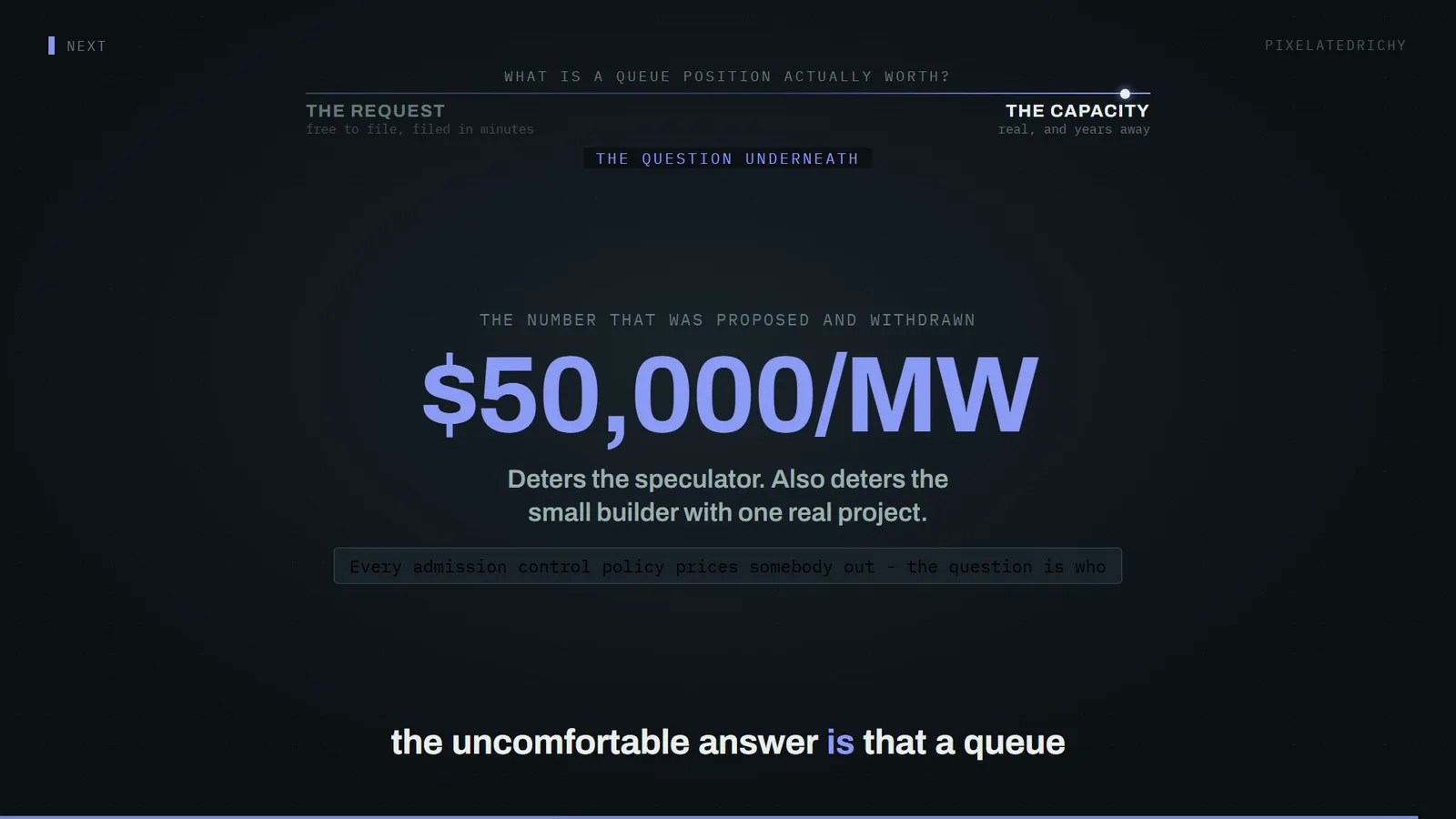
Which brings us to three days ago. The Texas Public Utility Commission adopted its final interconnection rules on the twenty-first of September, and the proposed version had contained exactly the mechanism I have been describing: a non-refundable fee of fifty thousand dollars per megawatt. A price that scaled with the reservation.
The one charge proportional to size is the one that came out.
The adopted rule removes it. The tiered study fees were replaced with a flat hundred thousand dollars for everybody. The window to report a missed milestone went from thirty days to twenty-four months.
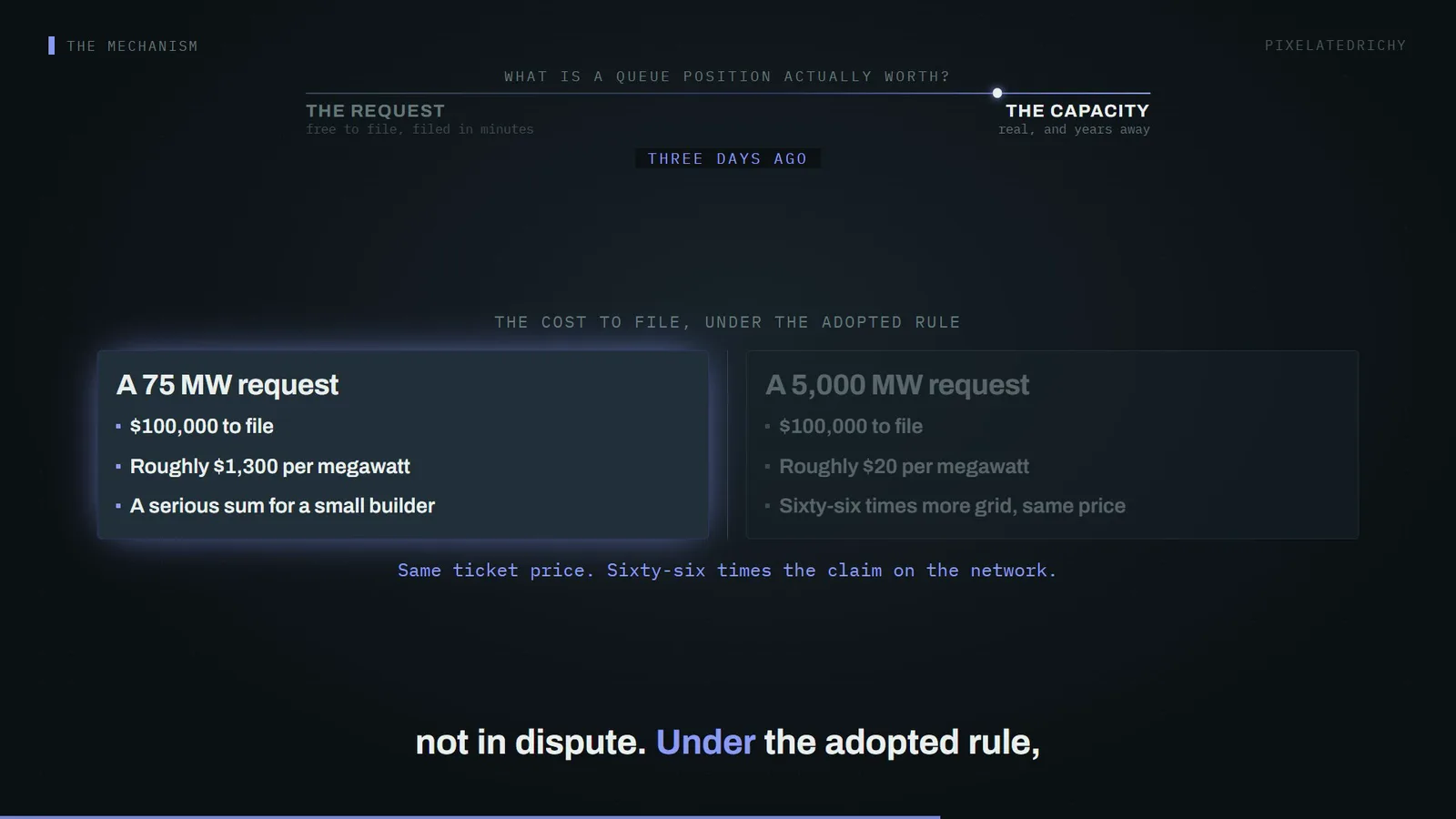
I want to be careful here, because I am describing what the rule does, not predicting what happens next. But the arithmetic is not in dispute. Under the adopted rule, a seventy-five megawatt request and a five thousand megawatt request cost precisely the same amount to file. Per megawatt reserved, the largest requests pay the least.
Back to the anomaly
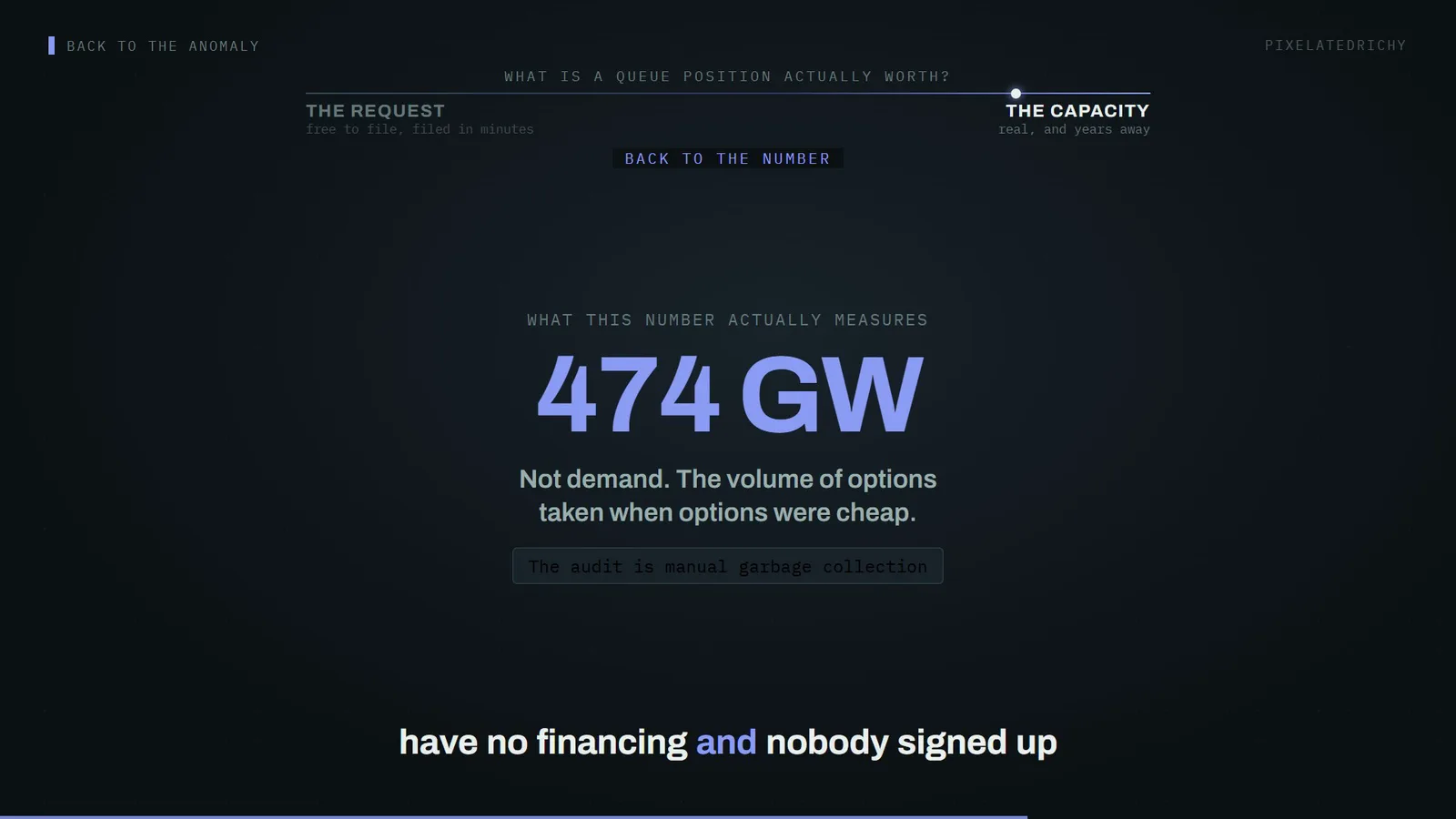
So, back to where we started. Four hundred and seventy-four gigawatts is not a measurement of how much electricity Texas is about to need. It is a measurement of how many free options were available and how many people took one. The Texas Tribune reported the plain reason so much of it is doubtful: a great many of those projects have no financing and nobody signed up to lease the space.
250 to 300 projects. About 200 GW. Target: 10 December.
And the response tells you which lever was left. On the third of August the governor ordered a verification and audit of the data centres in the queue, the operator paused its first batch of studies, and regulators set out to check between two hundred and fifty and three hundred projects by the tenth of December.
That is not admission control. That is an audit - going through by hand and asking each project to prove it exists. It is the thing you do when the front door never checked. And the pause itself is the bluntest instrument on the shelf: when you cannot price access, you close the gate.
Not total. Self-generating projects and areas outside ERCOT are unaffected.
It is worth being exact about that, because it has been reported loosely. The pause is not total. Projects bringing their own generation can go around it, and it only covers the grid this operator runs - El Paso, for instance, is on a different system entirely.
Where else this applies
Now the generalisation, which is why this is a systems story and not an energy story. A Kubernetes cluster where every team sets generous CPU requests and burns a fraction of them is exactly this. The scheduler refuses to place new work because the cluster is, on paper, full - while the nodes sit mostly idle. Reservations are free. Consumption is not.
Utilisation low, admission refused. Every time.
That pairing is the diagnostic. Whenever you see low measured utilisation next to a system insisting it has no room, you are looking at a reservation that costs less than the thing reserved.
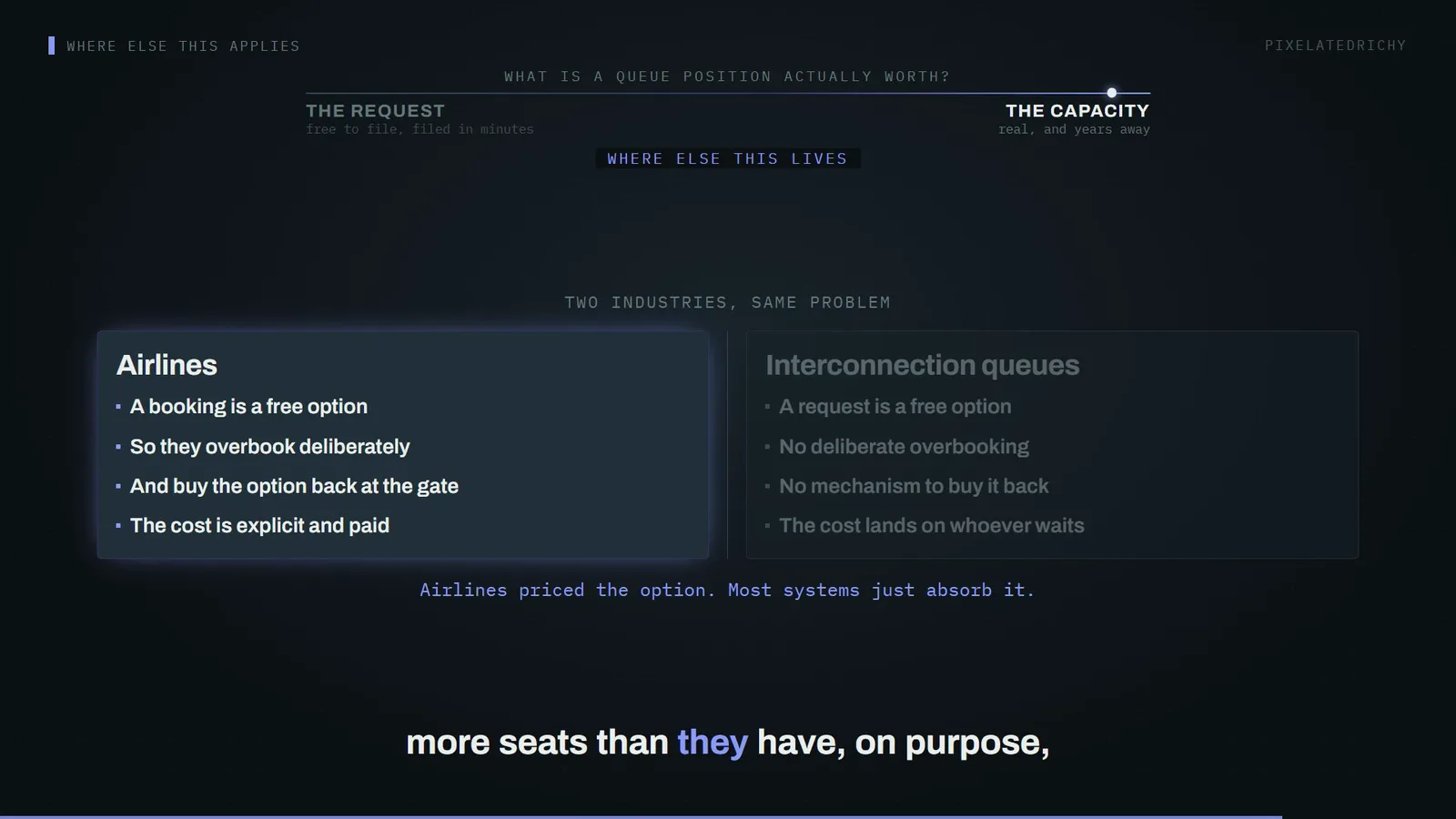
The comparison I like best is the airlines, because they are the one industry that faced this squarely. They know a booking is an option. So they sell more seats than they have, on purpose, and when too many people show up they buy the option back at the gate with cash and vouchers. It is unloved, and it is honest: the cost of free reservations is named, priced, and paid by the people who created it.
If reserving is free and the reservation is honoured, you are running an option market.
Most systems do neither. They hand out free options, honour them all, and let the cost fall on whoever happens to be waiting behind the ghosts.
What to look at next
So what is the right price for a queue position?
Which leaves the question the Texas rulemaking was actually arguing about, and it is harder than it looks. Fifty thousand dollars a megawatt is a real deterrent to somebody filing five speculative requests. It is also a real deterrent to a smaller operator with one genuine project and no balance sheet to speak of.
Admission control always prices somebody out. That is not a flaw in it, that is what it is for. The only question ever on the table is who - and the uncomfortable answer is that a queue which is fair to everyone who wants to join is a queue that has stopped rationing anything at all. Worth asking, of whatever you are running: what does it cost to reserve, what does it cost to use, and which of those two numbers is bigger.
Sources
- ERCOT is tracking more than 1,800 interconnection projects representing over 474 GW; Abbott states this is more than five times Texas' record peak demand and that ~90% of the requests are data centres
- Abbott: 'Interconnection queue requests total about 474 GW, which is more than five times Texas' record peak electricity demand for ERCOT'; ~90% of new power requests are data centres
- The audit covers 250-300 projects accounting for about 200 GW of future demand; many of the 1,800+ queued projects are unlikely to be built because they lack financing and signed tenants
- ERCOT aims to complete the governor's data centre audit by 10 December 2026
- Texas SB6: large load threshold of 75 MW and above unless the PUCT lowers it; flat initial transmission screening study fee of at least $100,000; curtailment capability required for noncritical large loads during firm load shed; backup generation serving 50%+ of demand must be disclosed and may be directed to run
- The Texas PUC adopted its final large-load interconnection rule on 21 September 2026, eliminating the proposed non-refundable interconnection fee of $50,000 per MW, replacing tiered study fees with a flat $100,000 study fee regardless of load size, and extending the missed-milestone notification deadline from 30 days to 24 months
- ERCOT's large load queue stood at about 63 GW at the end of 2024 and about 226 GW as of November 2025